




If you just picked up the Riftbound: Proving Grounds box and you’re staring at a pile of cards wondering where to start, this Riftbound TCG deck building guide is for you. We’rewalking through how to build a deck from scratch, step by step, using Garen, Might of Demacia as our example. By the end you’ll have a complete 40-card deck, a clear gameplan, and a good understanding of how all the pieces fit together.
What Goes Into a Riftbound TCG Deck?
Every constructed Riftbound deck has four components:
| Component | Details |
|---|---|
| Main Deck | 40 cards minimum. Max 3 copies of any single card. Can contain Units, Gear, and Spells. |
| Rune Deck | 12 rune cards matching your Legend’s two domain colors. These power your ability to summon units and cast spells. |
| Battlefields | 3 battlefield cards. One is chosen at random in best-of-one. In best-of-three, you actively pick one between games. |
| Champion Unit | Placed in the Champion Zone before the game starts. Not part of your 40-card main deck, though extra copies can still appear in your deck up to the 3-copy limit. |
Your deck can only contain cards from the two domains that match your Legend. Every card, including your runes, must belong to one of those two domains. This is called your Domain Identity.
Step 1: Choose Your Legend
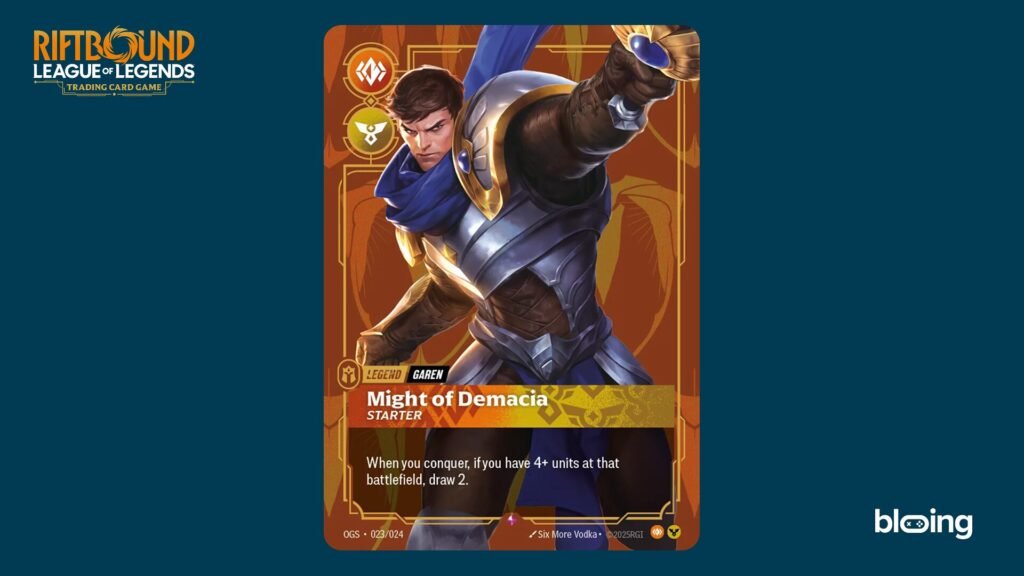
Your Legend defines your two domains, sets your Domain Identity, and provides a Legend Ability that’s always on. Everything else in your deck builds around it.
For this guide we’re building around Garen, Might of Demacia, one of the four Legends in the Proving Grounds box. Garen runs the Body (Orange) and Order (Yellow) domains. Body focuses on ramping resources and dropping big, high-Might units. Order handles token generation, direct kill effects, and board control. Together they create a mid-to-late game strategy built around flooding the battlefield with units and outlasting your opponent.
Garen’s Legend Ability: Whenever you conquer a battlefield with 4 or more of your units present, draw 2 cards.
Strong when it fires, but building to 4 surviving units consistently takes planning. This deck rewards patience over aggression.
Heads up: Garen is the most beginner-friendly Legend in Riftbound but he’s not the strongest competitively. Great for learning the game, just know what you’re working with going in.
Step 2: Choose Your Champion Unit
Each Legend has two Champion Unit variants, one per domain. Your Chosen Champion starts in the Champion Zone before the game begins and is not counted in your 40-card main deck, though copies of the card can still appear in your deck up to the standard 3-copy limit.
For this build we’re going with Garen, Rugged from Origins: Proving Grounds. He gains +2 Might when attacking or defending, making him a reliable combat piece at every stage of the game.
Step 3: Build Your Rune Deck
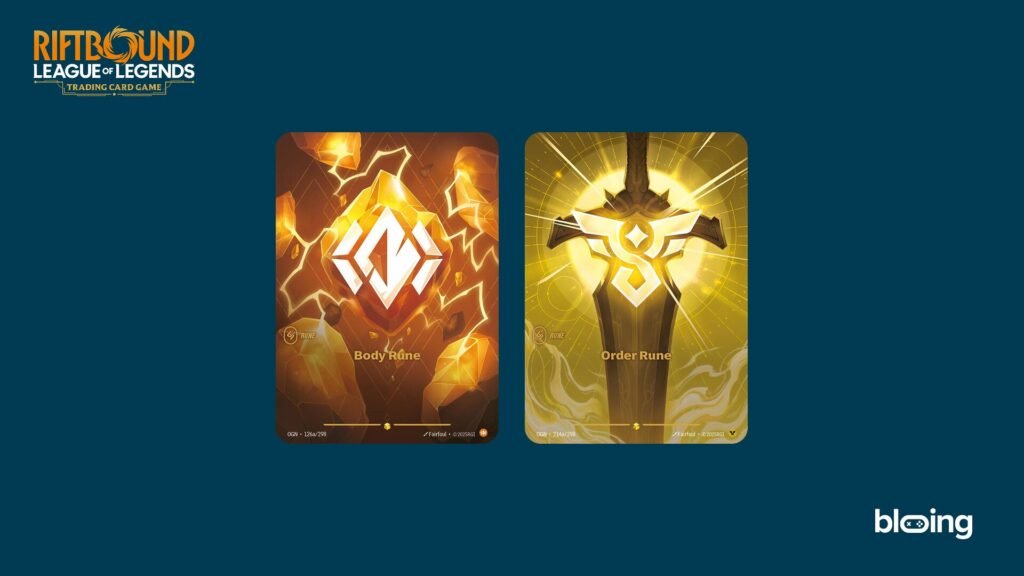
Since Garen uses Body and Order, your 12-card Rune Deck is split between those two colors:
| Rune Type | Color | Quantity |
|---|---|---|
| Body Runes | Orange | 6 |
| Order Runes | Yellow | 6 |
| Total | 12 |
The even split matches this deck’s balanced Power cost demands across both domains. If your build leans heavier on one domain, adjust the ratio accordingly.
Step 4: Choose Your Battlefields
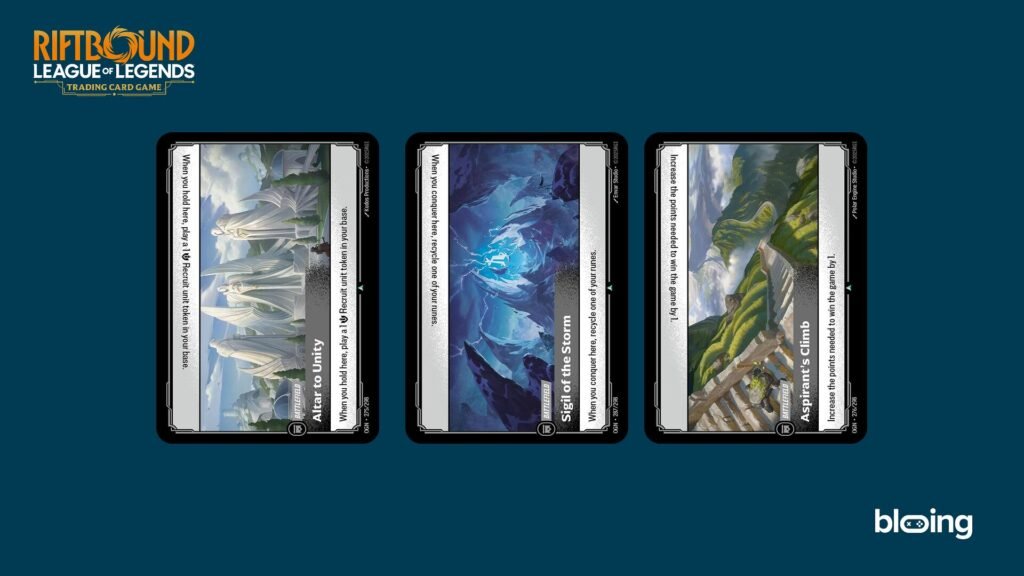
Good battlefield choices either reinforce your gameplan or help against strategies you expect to face. For this Garen build, we’re running:
| Battlefield | Effect |
|---|---|
| Altar to Unity | Generates a 1 Might Recruit token at your base every turn you hold it. Weak on their own, but they help trigger Garen’s draw ability and can be buffed or sacrificed to pay card costs. |
| Sigil of the Storm | Recycles your runes when conquered. Keeps your resource flow consistent across longer games. |
| Aspirant’s Climb | Increases the points needed to win by 1, raising the threshold from 8 to 9. Gives you extra time to develop your late-game threats. |
Step 5: Pick Your Units
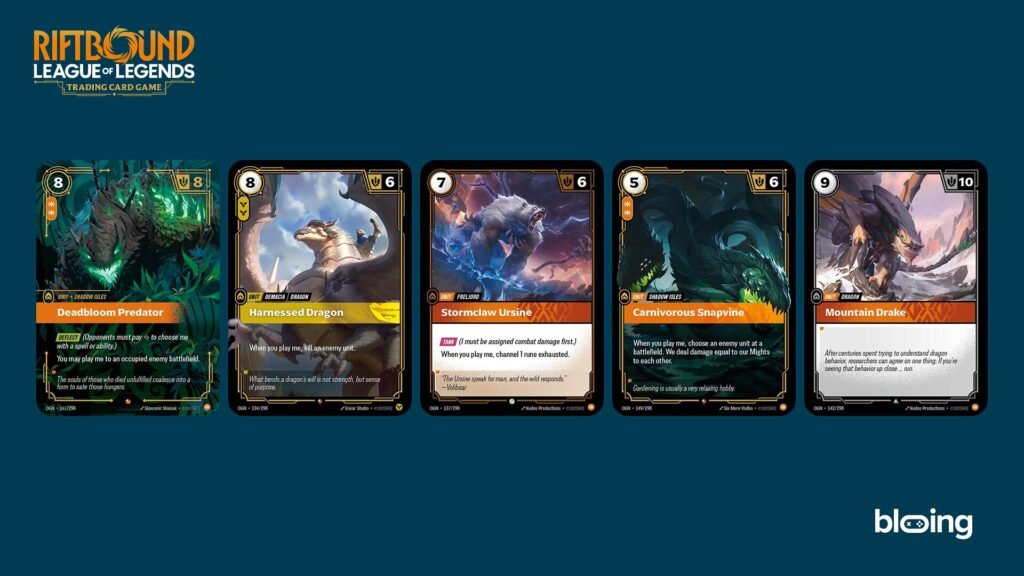
Aim for at least half your deck to be units. You need enough bodies on the board to contest battlefields consistently.
| Card | Copies | Energy | Might | Why It’s Here |
|---|---|---|---|---|
| Deadbloom Predator | 3x | 8 | 8 | Can be played directly onto an occupied enemy battlefield for immediate disruption. Deflect forces opponents to play a rune from their hand to target it with a spell or effect. |
| Harnessed Dragon | 3x | 8 | 6 | Destroys any enemy unit of your choice on summon, no conditions required. High cost but the removal effect justifies every rune. |
| Stormclaw Ursine | 2x | 7 | 6 | Tank keyword forces opponents to assign all combat damage to it first, protecting your lower Might units. Also has a built-in Channel effect that adds to your ramp setup. |
| Carnivorous Snapvine | 2x | 5 | — | On summon, choose an enemy unit at a battlefield. Both units deal damage equal to their respective Mights to each other. Since units fully heal after a combat showdown, a surviving Snapvine comes back to full strength for the next fight. |
| Mountain Drake | 1x | 9 | 10 | Your late-game finisher. One of the strongest non-champion units in the game. Deploy it once your ramp engine is fully online. |
Step 6: Fill Out Your Spells and Gear
Your spell and gear suite supports your units at every stage of the game.
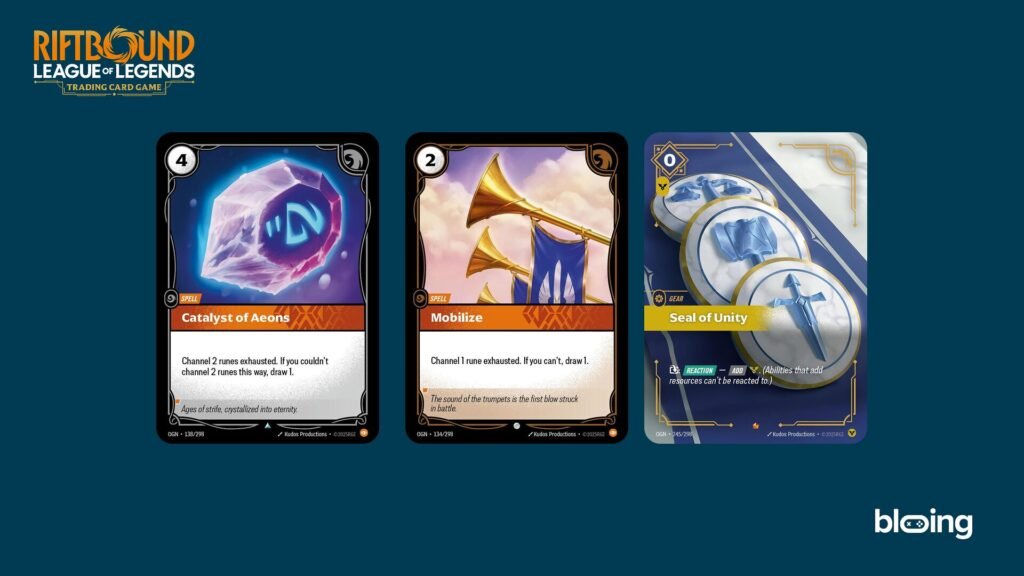
Ramp and Resources
| Card | Copies | Cost | Type | Effect |
|---|---|---|---|---|
| Catalyst of Aeons | 3x | 4 Energy | Spell | Channels 2 runes. Draws a card instead if you’re already at max resources. Your primary ramp spell. |
| Mobilize | 3x | 2 Energy | Spell | Channels 1 rune or draws a card if you can’t. Cheap, efficient, never dead. |
| Seal of Unity | 1x | 0 Cost | Gear | Exhaust to cover a Power cost without recycling a rune. Add keyword makes it an unstoppable Reaction your opponent can’t counter. |
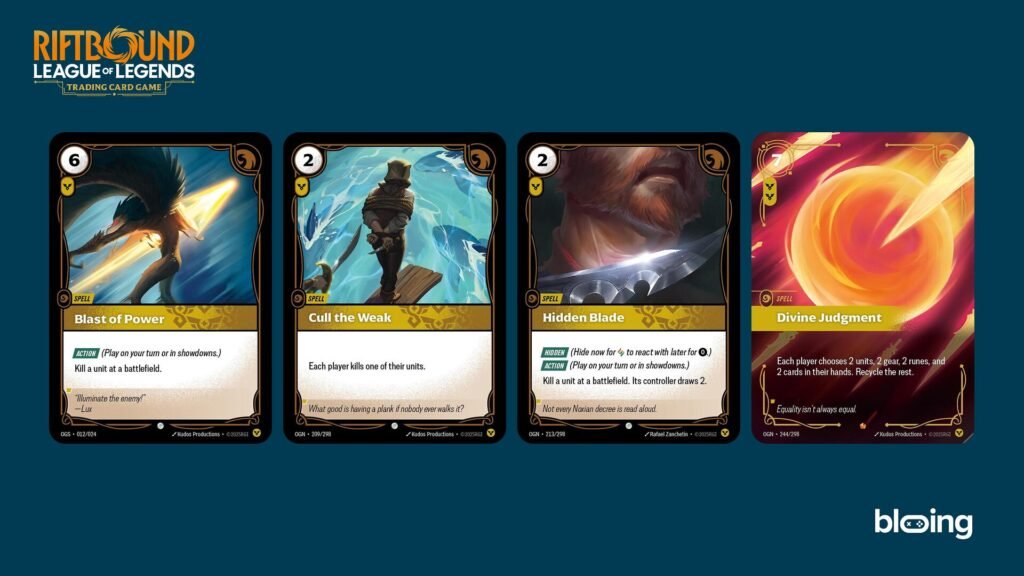
Removal
| Card | Copies | Cost | Type | Effect |
|---|---|---|---|---|
| Blast of Power | 3x | 6 Energy | Spell | Removes a unit at a battlefield. Playable on your turn or during showdowns. |
| Cull the Weak | 3x | 2 Energy | Spell | Both players destroy one of their units. Best when your opponent’s threat is more dangerous than what you’re giving up. |
| Hidden Blade | 3x | 2 Energy | Spell | Removes a unit but gives your opponent 2 cards. Use it when the threat you’re removing is worth more than two cards in their hand. |
| Divine Judgment | 3x | 7 Energy | Spell | Each player keeps 2 units, 2 gear, 2 runes, and 2 cards from hand. Everything else recycled. Active player chooses first — always cast this on your own turn. |
Combat Tricks
| Card | Copies | Cost | Type | Effect |
|---|---|---|---|---|
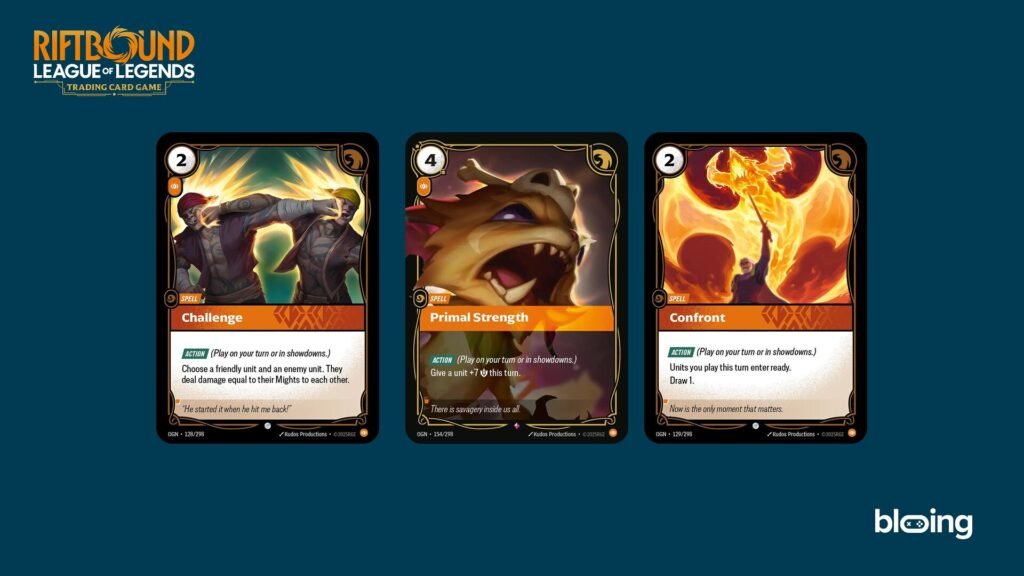
| Challenge | 2x | 2 Energy | Spell | A friendly and enemy unit deal damage equal to their Mights to each other. High value when you have the bigger unit. |
| Primal Strength | 1x | 4 Energy | Spell | Gives a unit +7 Might for the turn only. Use it as a surprise during a showdown your opponent thinks they’re already winning. |
| Confront | 2x | 2 Energy | Spell | All units you play this turn enter Ready instead of Exhausted, so they can move or attack immediately. Also draws a card. |
Utility and Recursion
| Card | Copies | Cost | Type | Effect |
|---|---|---|---|---|
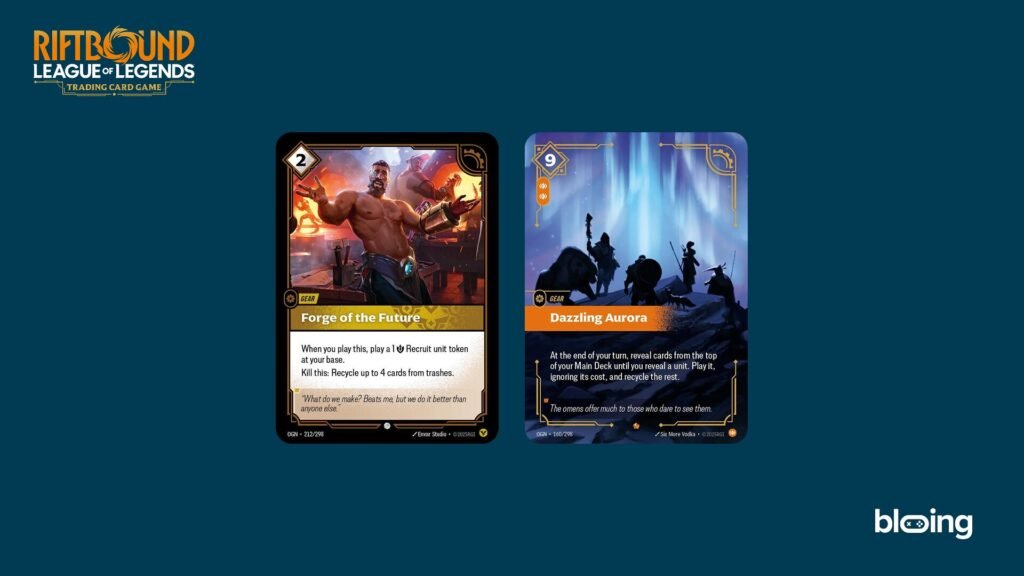
| Forge of the Future | 1x | 2 Energy | Gear | Generates a 1 Might Recruit token. Destroy it later to recycle any 4 cards from either player’s discard — units, spells, or gear in any combination. |
| Dazzling Aurora | 3x | 9 Energy | Gear | At the end of every one of your turns while it’s on the board, reveal cards until you hit a unit and play it for free. Your engine for cheating big threats into play. |
Quick Reference Decklist
Legend: Garen, Might of Demacia Champion: Garen, Rugged Runes: 6 Body (Orange) + 6 Order (Yellow)
Battlefields
| Card | Copies |
|---|---|
| Altar to Unity | 1 |
| Sigil of the Storm | 1 |
| Aspirant’s Climb | 1 |
Units (12)
| Card | Copies |
|---|---|
| Deadbloom Predator | 3 |
| Harnessed Dragon | 3 |
| Stormclaw Ursine | 2 |
| Carnivorous Snapvine | 2 |
| Mountain Drake | 1 |
| Garen, Rugged | 1 |
Spells and Gear (28)
| Card | Copies |
|---|---|
| Catalyst of Aeons | 3 |
| Mobilize | 3 |
| Blast of Power | 3 |
| Cull the Weak | 3 |
| Hidden Blade | 3 |
| Divine Judgment | 3 |
| Dazzling Aurora | 3 |
| Challenge | 2 |
| Confront | 2 |
| Seal of Unity | 1 |
| Primal Strength | 1 |
| Forge of the Future | 1 |
How This Deck Plays
Garen takes a few turns to get going, and that’s by design.
Early game — ramp and stabilize. Use Catalyst of Aeons and Mobilize to get ahead on resources. Generate tokens through Altar to Unity. Use Hidden Blade and Cull the Weak to stay even on board.
Mid game — apply pressure. Deploy Harnessed Dragon and Deadbloom Predator ahead of curve. Carnivorous Snapvine cleans up threats in the way. Start building toward 4+ units at a battlefield to trigger Garen’s draw ability.
Late game — close it out. Dazzling Aurora pulls Mountain Drake or Harnessed Dragon for free. Cast Divine Judgment on your turn to lock in your win conditions while dismantling your opponent’s setup. Aspirant’s Climb buys you the extra turn you need.
Common Mistakes to Avoid
- Casting Divine Judgment on your opponent’s turn. The active player always chooses first. Cast it on your turn so you lock in your board before they can react.
- Overloading on spells and gear early. Spells support your board — they don’t replace it. If you have no units on the field, your removal spells won’t win you the game.
- Forcing Garen’s draw ability too early. Don’t sacrifice board position just to trigger the draw. Let it happen naturally in the mid-to-late game when your board is already wide.
- Playing Hidden Blade on a weak unit. You’re giving your opponent 2 cards every time. Make sure what you’re removing is worth that trade.
- Holding Mountain Drake too long. It’s your finisher, not a card to sit on. Once Dazzling Aurora is on the board, let it do its job.
Where to Get the Cards
The Riftbound: Proving Grounds box is the easiest starting point for anyone following a Riftbound TCG deck building guide. It includes four pre-constructed decks including the Garen pre-con, plus Annie, Lux, and Master Yi. All four contain cards you can pull into a Garen build as you experiment and refine your playstyle.
Beyond that, pick up singles gradually, trade with other players, or open booster packs from the Origins set to fill in the gaps. If you want to match the exact list above, tracking down singles is the most efficient route.
Frequently Asked Questions About Riftbound TCG Deck Building
These are the most common questions players have when following a Riftbound TCG deck building guide for the first time.
A Riftbound deck requires 40 cards in the main deck, a 12-card Rune Deck, 3 battlefield cards, and 1 Champion Unit placed in the Champion Zone before the game starts.
You win by reaching 8 victory points before your opponent. You earn points by conquering a battlefield or by holding one. Conquering means your units successfully took control of a battlefield during combat. Holding means you have at least one unit at a battlefield at the start of your turn with no opponent contesting it. Note that you cannot score your winning 8th point from conquering alone unless you also conquered every other battlefield that same turn. Most winning points come from holding.
Your Domain Identity is the two domains set by your Legend card. Your deck, including your rune cards, can only contain cards that belong to those two domains. If your Legend runs Body and Order, you cannot include any Fury, Calm, Mind, or Chaos cards.
You can run a maximum of 3 copies of any single card. This limit includes your Champion Unit slot. If Garen, Rugged is your Chosen Champion, you can still include up to 2 more copies of him in your main deck.
Runes are your resource cards. At the start of each turn you channel 2 runes from the top of your Rune Deck, placing them face-up in front of you. You can exhaust a rune by turning it sideways to generate Energy, or recycle it by sending it to the bottom of your Rune Deck to generate Power for more expensive card effects. Unspent resources are lost at the end of your turn.
Yes. Riftbound is designed to support both new and experienced TCG players. The Proving Grounds box includes four pre-constructed decks that are ready to play out of the box, including a Garen deck. The rules are straightforward to learn, especially if you have prior experience with other card games like Magic: The Gathering or Pokemon TCG.
Yes. Garen, Might of Demacia is the most beginner-friendly Legend in Riftbound. His gameplan is straightforward: build a wide board, ramp up resources, and close out with big units. He is not the strongest competitively, but he is an excellent starting point for learning the game.
Conquering scores you 1 point immediately when your units take control of a battlefield during combat. Holding scores you 1 point during your Beginning Phase when you already have at least one unit at a battlefield with no opponent contesting it. Both count toward your 8 point win condition.
Yes. You can assemble a deck by buying individual singles, trading with other players, or opening booster packs from the Origins set. The Proving Grounds box is the most cost-effective starting point since it includes four ready-to-play decks.
Follow Blooing on Facebook, YouTube, and TikTok for more Tabletop news and reviews.










Leave a comment